












Sterile Filtration of Wine: 0.45 µm vs 0.65 µm Membrane Filters
October 22, 2026
Sterile wine filtration is the last point at which a winery can physically remove yeasts and bacteria before a wine is sealed. Once the wine is bottled, any organisms that remain travel with it through storage, distribution and retail, where they can cause refermentation, haze or off-flavours long after it has left the winery. That is why the final membrane step before bottling is watched so closely.
For most wineries, the choice comes down to two membrane ratings: 0.45 µm and 0.65 µm (a micron, or µm, is one thousandth of a millimetre). In Australia, 0.45 µm membrane media are the usual choice (Wine Australia), but the tighter grade is not automatically right for every wine. Selecting between them means balancing microbial risk against filterability, flow rate and membrane life, and the sections below explain how each of those plays out.
What Is Sterile Filtration in Winemaking?
Sterile filtration passes wine through a fine membrane that physically holds back microorganisms. Yeast and bacteria are far too small to see, so a wine can look perfectly clear and still contain live cells.
To catch organisms that small, the membrane needs to be absolute rated, meaning its stated pore size is the largest opening in the filter. Nominal filters only remove a percentage of particles at their rating, and the same applies to cross-flow filtration, which is widely used to clarify wine but cannot be integrity tested before use, so neither replaces a final membrane (AWRI). Filters not using a specified membrane will only target particles within the wine, and cannot be relied upon for sterility.
0.45 µm vs 0.65 µm Wine Filters: What’s the Difference?
Among absolute-rated membranes, a 0.45 µm membrane has a tighter structure and higher retention, while a 0.65 µm membrane trades some retention for more open flow. The gap shows in validated retention data, reported as a log reduction value (LRV). An LRV of 4 means roughly 1 in 10,000 organisms passed through in a laboratory challenge, and an LRV of 6 means 1 in a million.
The table below draws on the technical data for Bevpor PH, a polyethersulphone (PES) beverage membrane cartridge supplied by BHF. It focuses on two common wine spoilage organisms because both were tested at each grade, which allows a like-for-like comparison.
| Organism | Type | 0.45 µm LRV | 0.65 µm LRV |
| Lactobacillus brevis | Lactic acid bacteria | >9 | 5 |
| Brettanomyces | Spoilage yeast | >6 | 4 |
Both grades reduce these spoilage organisms substantially, yet the 0.45 µm grade retained far more of each. For yeast, BHF’s guide to filter characteristics notes that the 0.45 µm Bevpor PH membrane is fully retentive of Saccharomyces cerevisiae, the main yeast used in wine fermentation. In plain terms, no yeast cells passed through the membrane under test conditions. Because manufacturers test against different organisms and conditions, retention should be checked for the specific cartridge rather than assumed from pore size.
0.45 µm Membrane Filters
That higher retention makes 0.45 µm the natural fit for wines with a real risk of microbial activity after bottling, particularly those with residual sugar, which industry guidance recommends sterile filtering (Wine Australia). It is also the safer option where lactic acid bacteria or Brettanomyces have been an issue.
0.65 µm Membrane Filters
A 0.65 µm membrane, by contrast, can suit dry wines with low microbial counts and well-controlled cellar hygiene. It can also sit directly ahead of a 0.45 µm stage to take load off the final membrane. It may be chosen for wines that don’t require a true sterile filtration level.
How to Choose Between 0.45 µm and 0.65 µm
Residual sugar, covered above, is often the first question. Beyond that, three practical factors usually make the final call:
- Microbial risk: laboratory counts and the wine’s history show which organisms are present and how much protection the wine needs, pointing towards either the tighter 0.45 µm grade or the more open 0.65 µm grade.
- Filterability: a wine can look clear and still block a membrane, because some of the material that causes blockages does not show up as cloudiness. A filterability test shows how the wine will actually behave on the membrane.
- Flow and temperature: a faster bottling line needs more membrane area, and temperature affects how easily wine passes through, so testing should be done at the temperature the wine will be at on bottling day.
Where Sterile Filtration Fits in the Bottling Process
Filterability points to a wider principle: either grade only performs well if the wine reaching it is already clean, which is why the final membrane sits at the end of a sequence:
- Clarification and stabilisation: settling, fining, centrifugation or cross-flow remove the heavy solids left after fermentation.
- Prefiltration: depth sheets, lenticulars or pleated prefilters catch fine particles and colloids that would clog the membrane.
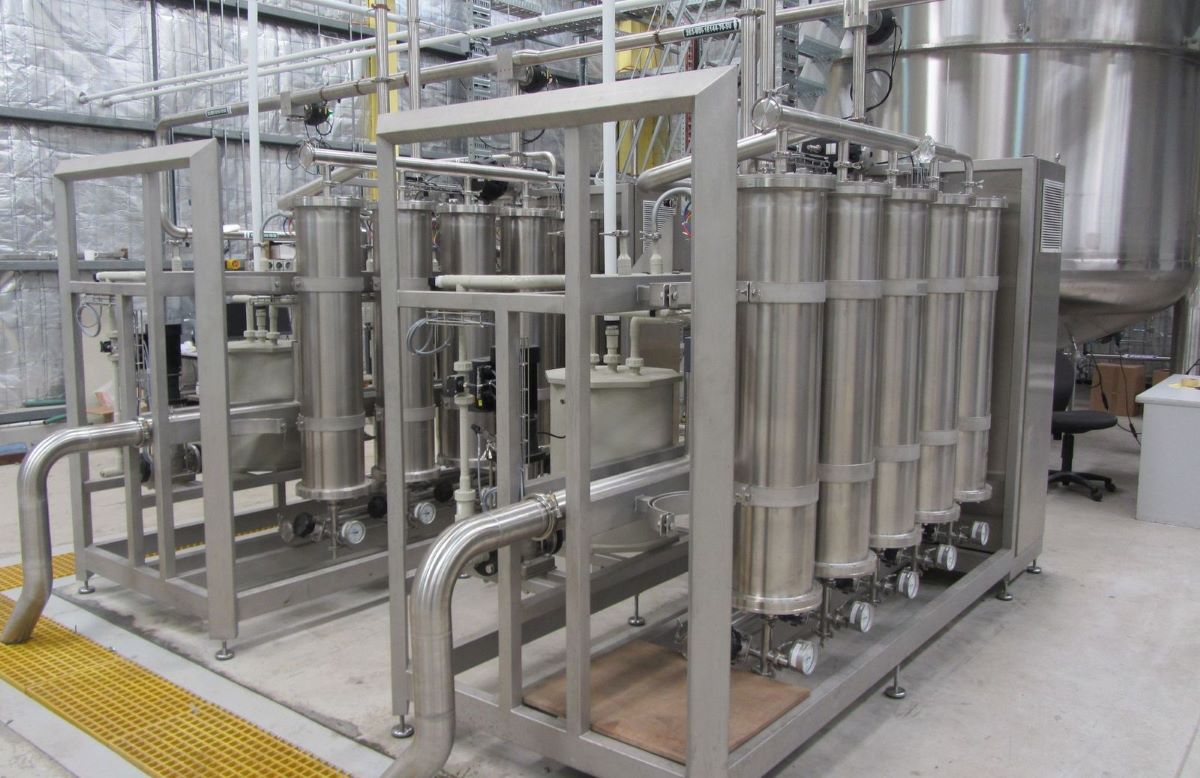
- Final membrane filtration: the membrane is integrity tested before the run, using a bubble point or pressure hold test, to confirm there are no leaks.
- Hygienic bottling: wine should go straight from membrane to filler, as holding it in a tank for days or sweetening it afterwards lets microbes return (AWRI).
Common Mistakes That Shorten Membrane Life
With that sequence in place, membrane life depends mostly on how cartridges are run and maintained, and two mistakes in particular come up often in day-to-day operation. The first is ignoring differential pressure, the pressure difference between housing inlet and outlet; a steady rise means the membrane is loading, and exceeding the limit (5.0 bar at 20 °C for Bevpor PH) risks damage. Typically the cartridges should be changed when the differential pressure exceeds 2.5 bar, with the earlier limit representing the collapse point. The second is skipping sanitisation between runs, even though cartridges like Bevpor PH tolerate hot water at up to 90 °C and steam at up to 130 °C. Another area that will shorten membrane life, although less commonly, is improper preparation and running of integrity testing, where excessive conditions can cause membrane failure and permanent damage requiring replacement membranes.
How BHF Supports Each Stage of Wine Filtration
All of those mistakes point to a broader lesson: a final membrane performs best when it is treated as the last link in a chain rather than a standalone purchase. BHF’s range follows that same sequence. Beco depth sheets and lenticulars and Prepor NG prefilters prepare the wine, and Propor ME cartridges, which provide particulate removal and microbial reduction in wine applications, are often placed directly ahead of Bevpor PH cartridges at the final membrane stage. For wineries looking at an existing setup, a site audit can assess how well each stage is performing.
Getting Sterile Wine Filtration Right
For sterile wine filtration, a 0.45 µm membrane gives the highest retention and remains the safer choice for wines that could referment, while 0.65 µm can suit lower-risk dry wines or work as a protective stage ahead of the tighter grade. Neither grade works in isolation, though. Consistent results come from clean wine reaching the membrane, retention data checked for the specific cartridge and wine moving straight from filter to bottle.
Talk to Our Team
If you are weighing up final filter options ahead of a bottling run, contact our team to talk through the wine, the line and the membrane grade that suits both.
Frequently Asked Questions
Usually because of polysaccharides that turbidity readings miss. Glucanases and other enzymes can break these down so the wine filters freely.
A pressure-based test, such as a bubble point or diffusion test, is run on the wetted membrane before bottling to confirm there are no leaks or damaged seals. The test pressure depends on the grade; for Bevpor PH it is 1.4 bar for 0.45 µm and 1.0 bar for 0.65 µm, with a maximum diffusional flow of 21 mL per minute for a 10-inch cartridge.
Yes, provided they are cleaned properly and keep passing integrity tests. Beverage membranes such as Bevpor PH are designed to be regenerated, sanitised and integrity tested repeatedly, which extends their service life across bottling runs.