











Understanding Differential Pressure as a Diagnostic Tool for Filter Performance
January 20, 2026
BHF Technologies Pty Ltd
Introduction
Differential pressure (DP or ΔP) is one of the most important in-situ indicators available to process operators for assessing the condition and performance of filters. When correctly measured and interpreted, ΔP provides real-time insight into filter loading, system health, and early indicators of remaining filter service life.
However, differential pressure is influenced by multiple operational and design factors. Misunderstanding these factors can lead to premature filter change-out, filter damage, or reduced process efficiency.
This article outlines the fundamentals of differential pressure measurement across filters, the key variables that influence ΔP, and the operational considerations required to ensure reliable and safe filtration performance.
Definition and Measurement of Differential Pressure
In its simplest form, differential pressure is the pressure drop across a component:
ΔP = Pupstream − Pdownstream
In filtration applications, ΔP is measured using pressure gauges or transmitters installed immediately upstream and downstream of a filter housing. To ensure meaningful data, only a single filter housing or pressure-reducing element should exist between the two measurement points.
If multiple filters or restrictions are installed between gauges, it becomes impossible to determine which component is responsible for the observed pressure loss.
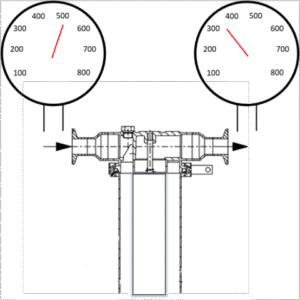
Example
- Upstream pressure: 500 kPa
- Downstream pressure: 350 kPa
ΔP = 500 − 350 = 150 kPa
A differential pressure of 150 kPa indicates resistance across the filter. Depending on filter design, cleanliness, and downstream requirements, this may indicate partial blockage and the need to plan for replacement.
In two-stage filtration systems, differential pressure must be monitored independently for each filter. The downstream pressure of the first filter becomes the upstream pressure of the second. Failing to account for this relationship can lead to incorrect conclusions about filter condition.
Factors Influencing Differential Pressure
Differential pressure is not solely a measure of filter blockage. Several factors influence ΔP:
- Micron rating: Finer filters typically exhibit higher clean differential pressure.
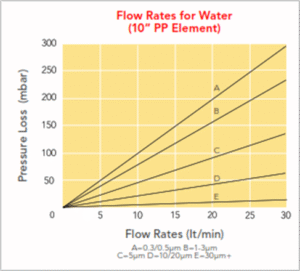
- Particulate loading: As solids accumulate, flow resistance increases.
- Flowrate: Higher flowrates or insufficient filter area increase ΔP.
- Fluid viscosity: More viscous fluids generate higher pressure drop.
- Presence of liquids or condensate: Particularly critical for hydrophobic filter media.
Other system components can also affect pressure readings, including pressure-reducing valves, regulators, pipe size changes, elevation differences, and downstream valve positions.
Manufacturer Limits and Temperature Effects
Filter manufacturers specify maximum allowable differential pressure and recommended change-out limits. These values are temperature-dependent and must be respected to avoid filter failure.
At elevated temperatures, particularly during hot water or steam sanitisation, polymer-based filter media lose mechanical strength. As temperature increases, the allowable ΔP decreases significantly.
During steam-in-place (SIP) cycles, differential pressure should be kept to an absolute minimum. Manufacturer guidance must always be followed, as allowable ΔP during steaming is often less than 0.2 bar.
Flow Direction and Operational Modes
Differential pressure behaviour changes depending on flow direction. In reverse-flow conditions, allowable ΔP is typically lower due to reduced structural support of the filter media.
All operational modes must be considered during system design and filter selection:
- Normal forward filtration
- Reverse flow events
- Clean-in-Place (CIP)
- Steam-in-Place (SIP) or sanitisation cycles
Ignoring these conditions can result in filter damage even when normal operating ΔP appears acceptable.
Filter Sizing and Clean Differential Pressure
Proper filter sizing is critical for achieving acceptable clean differential pressure and maximising filter service life.
Undersized systems exhibit high clean ΔP, reducing the margin before change-out limits are reached. This results in shorter service intervals and higher operating costs.
Increasing filter surface area reduces clean ΔP but requires larger housings and higher capital investment. An optimal balance must be achieved between:
- Clean differential pressure
- Filter life
- Housing size
- Operating and maintenance costs
Steam Sanitisation of Hydrophobic Gas Filters
Hydrophobic gas filters are commonly used in food and beverage applications to provide microbial barriers for gases such as compressed air, carbon dioxide, and nitrogen. These filters typically use PTFE membrane media and are routinely sanitised using steam.
At typical SIP temperatures of 121 °C, filters experience significant thermal and mechanical stress. Under these conditions:
- Differential pressure must remain extremely low
- Steam flow should be slow and controlled
- Reverse-flow steaming further reduces allowable ΔP
Exceeding manufacturer limits during SIP can permanently damage filter media. Adequate cooling time after sanitisation is essential before resuming normal operation.
Risks Associated with Condensate and Liquid Contact
Hydrophobic filter media repel liquids. If condensate or water contacts the media, gas flow may be restricted or completely blocked, causing a rapid increase in differential pressure.
Inadequate condensate management during SIP can result in:
- Temporary or permanent blockage
- Filter media damage
- False indications of severe fouling
SIP is intended for thermal sanitisation, not particulate removal. Steam quality, flow control, and condensate removal are therefore critical.
Similar risks occur when hydrophobic filters installed on tank vents are exposed to liquid splashing or overfill conditions. In extreme cases, this can result in dangerously high ΔP and potential vessel damage.
Conclusion
Differential pressure is a powerful diagnostic tool for monitoring filter performance when properly understood and applied. Accurate gauge placement, appropriate filter sizing, awareness of temperature and flow direction effects, and careful management of CIP and SIP conditions are essential.
By trending differential pressure and understanding the variables that influence it, operators can extend filter life, protect equipment, and maintain safe and reliable filtration systems.